Key points
- Read a liquid measuring cup on a level counter, with your eye at the line.
- Use a liquid cup for water and milk, and a dry cup for flour and sugar.
- NIST gives 2 cups as about 16 fluid ounces, or about 480 mL.
- Choose a size by the biggest amount you pour at once, not the smallest.
Read the line at eye level, on a flat counter
Liquid does not sit flat against glass. It curves up where it touches the sides, and that curve is called the meniscus. NIST, the federal measurement lab, puts the rule plainly: set the fluid measuring cup on a level surface and read the meniscus at eye level. If you look down at it from above, the liquid seems to reach a higher line than it does, and you end up pouring too little.
In practice, you stop pouring a little early, set the cup down and crouch until your eye is even with the markings. Then top up in small splashes. A cup held in the air tilts in your hand, and a tilted surface turns every line into a guess.
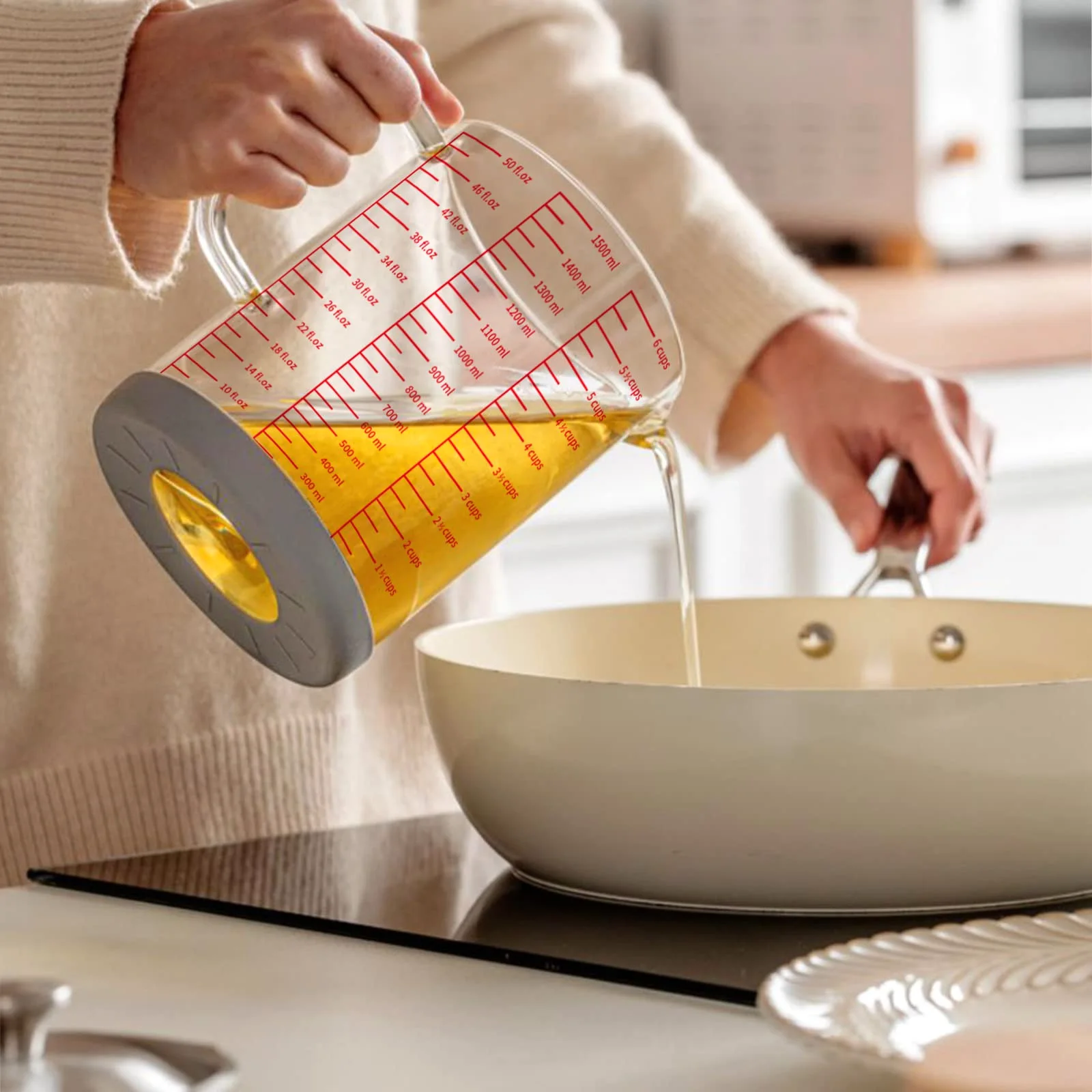
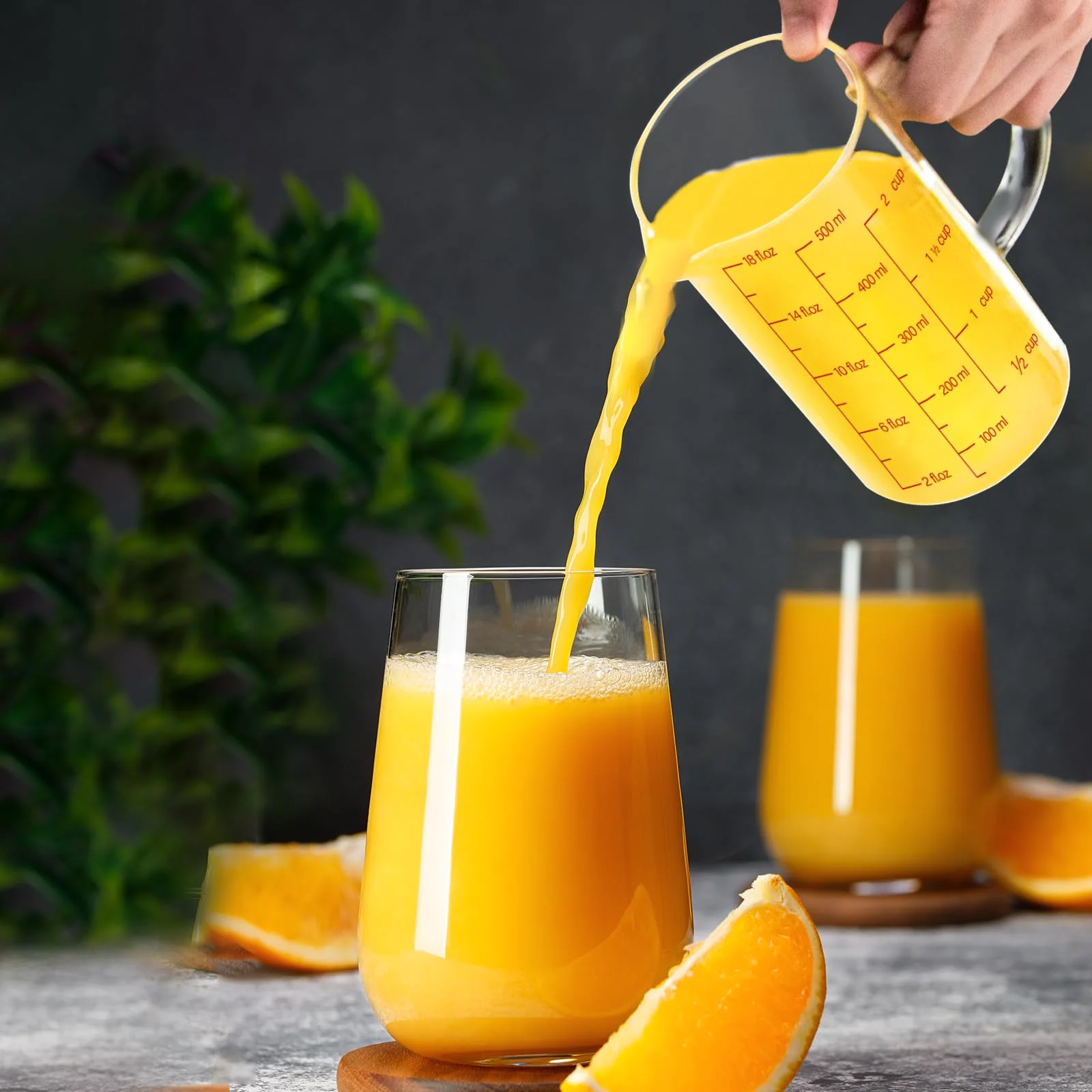
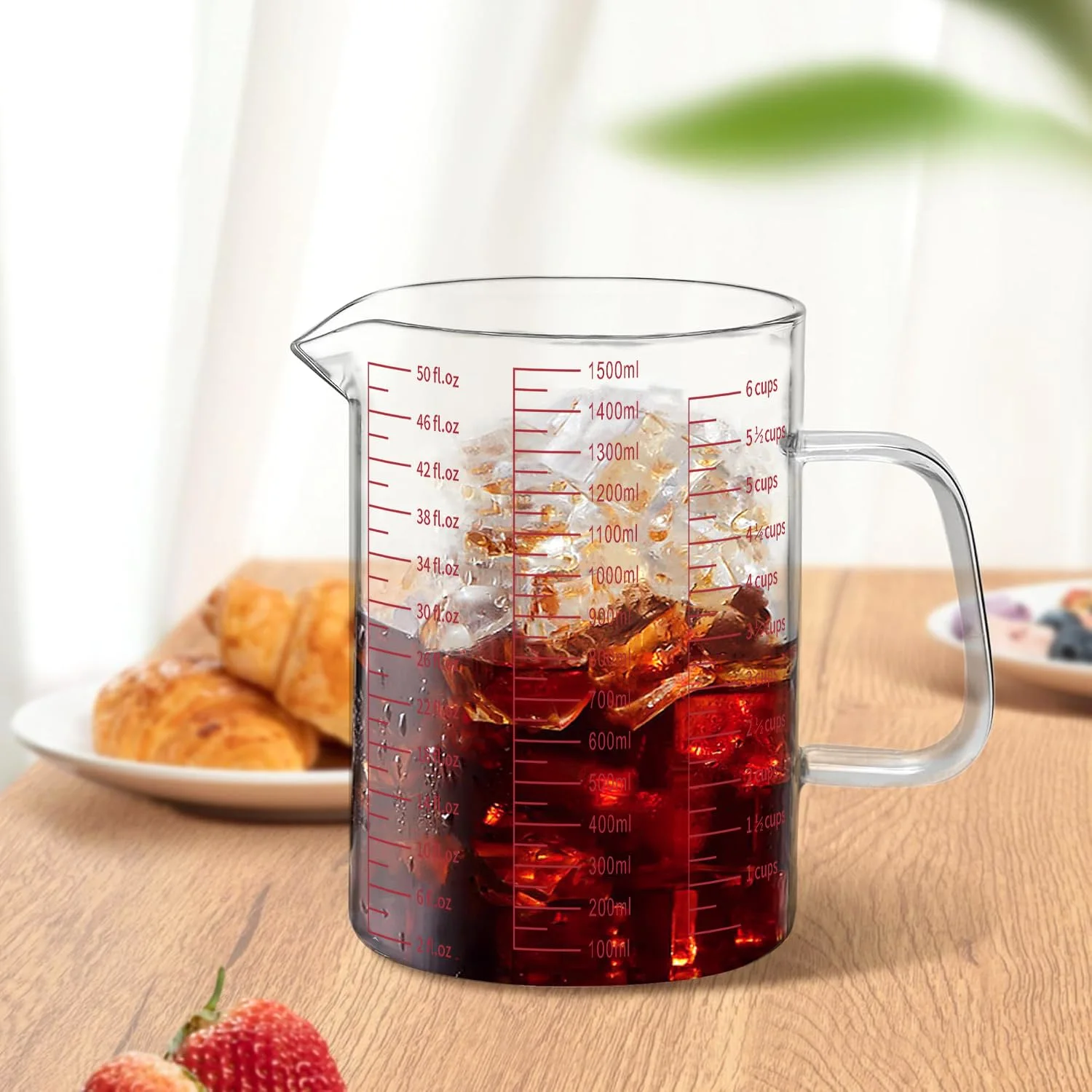
Our glass measuring cups print three scales on the glass: cups, ounces and milliliters. Pick the scale your recipe uses and read only that one. You skip the conversion in your head, and you never mix two units inside one recipe.
Liquid cups and dry cups are different tools
A glass cup with a spout and a handle is a fluid measuring cup. A set of nested cups that you fill to the rim is a dry measuring cup. NIST warns that using a dry measuring cup in place of a fluid one is a common way of introducing measurement errors. Water poured into a dry cup spills before it reaches the rim, and sugar in a liquid cup settles below a line you cannot level.
For flour, sugar and oats, NIST advises you to strike off the excess when you use a dry cup. Scoop, then sweep a straight edge across the top. For the most exact baking, NIST calls weighing ingredients on a kitchen scale a best practice.
A glass cup still earns its spot in that kitchen. It holds the milk, the oil and the beaten eggs before they go into the bowl, and you pour them from the spout without a funnel.
Cups, ounces and milliliters on one glass
Recipes from different countries mix units, and you will meet milliliters in one book and cups in the next. NIST publishes approximate equivalents between metric and US kitchen measures, and a few of them are worth knowing by heart.
NIST lists 240 mL as about 1 cup, and 480 mL as about 16 fluid ounces, which is 1 pint or 2 cups. A quart, or 4 cups, comes to about 950 mL. A single fluid ounce is about 30 mL. NIST calls every one of these approximate, so use them for converting a recipe, not for splitting hairs.
Those figures also tell you how much room a cup gives you. Our 4 cup size holds 1000 ml, a little more than the 950 mL NIST gives for 4 cups. A full quart of stock fits with a margin at the top, and you carry it to the pot without a spill.
| Metric | US measure |
|---|---|
| 30 mL | 1 fluid ounce |
| 180 mL | 6 fluid ounces (3/4 cup) |
| 240 mL | 1 cup |
| 480 mL | 16 fluid ounces (1 pint, 2 cups) |
| 950 mL | 32 fluid ounces (1 quart, 4 cups) |
Which size to buy
Choose the size by the largest amount you measure in one go. If a recipe calls for 3 cups of stock and you own a 2 cup glass, you pour twice and lose count somewhere in between. A cup that is too big costs you only a little drawer space.
The 2 cup size holds 18 ounces and fits a crowded drawer. It covers the daily jobs: milk for coffee, a vinaigrette, melted butter for popcorn. The 4 cup size holds 34 ounces and is the everyday middle. A quart of stock, a pan of gravy or the eggs for an omelet all fit in it.
The 6 cup size holds 50 ounces and doubles as a mixing bowl. Pancake batter for a family goes in, gets whisked and pours onto the griddle from the V spout. At the table, it serves as a jug for iced tea.
| Size | Holds | Markings | Suits |
|---|---|---|---|
| 2 cup glass | 18 oz, 500 ml | Cups, ounces, milliliters | Milk, dressings, melted butter |
| 4 cup glass | 34 oz, 1000 ml | Cups, ounces, milliliters | Stock, gravy, whisked eggs |
| 6 cup glass | 50 oz, 1500 ml | Cups, ounces, milliliters | Pancake batter, iced tea |
| 1 gallon pitcher | 134 oz, 4000 ml | Engraved into the plastic | Brine, party drinks, garden and pool water |
When a gallon pitcher makes more sense
Some jobs outgrow any glass cup. A turkey brine, a party batch of lemonade or the water for a garden sprayer can run to a gallon. Measuring that in 6 cup pours means a long row of tally marks and a good chance of losing one.
Our 1 gallon measuring pitcher holds 4000 ml, or 134 ounces. It is food-grade polypropylene, light enough to hold steady if it slips out of a wet hand, and it weighs only 0.34 kg empty.
The markings are engraved into the plastic rather than printed, so the dishwasher does not wash them off. The handle is wide and ridged for a wet or gloved grip. If you also measure pool chemicals or car fluids, keep one pitcher for food and a second one for the garage, and never swap them.
Warming milk and butter in the same cup
A glass cup is also a vessel you heat in. USDA FSIS lists heatproof glass among the containers that are safe to use in the microwave. The thin tubs that butter spread and yogurt come in are on its other list. Warm milk or butter right in the cup you measured it in.
FSIS gives three habits for the microwave. Loosen or vent any cover so steam can escape. Stir, rotate or turn the food midway through. After you take it out, let it stand for at least 3 minutes before you use it.
Warm milk can foam up the sides, so leave room in the cup. That is one more reason to own a size up. The handle of our cups is a separate insulated piece and stays cooler than the glass, but the glass itself gets hot, so steady it with a towel when you pour.
To keep the lines readable for years, wash the cup by hand or in the dishwasher with a mild detergent. Strong acid or alkaline cleaners dull the glass. You can compare every size side by side on glass measuring cups. For the containers your leftovers go into next, see our guide to storing leftovers in glass.
Every product named here is part of the Luvan range.