Key points
- The CDC lists uncut grapes, berries, cherries and melon balls among foods to avoid for young children.
- The AAP says to cut food for infants and young children into pieces no larger than one-half inch.
- Stay with your child for the whole meal, and keep them sitting up while they eat.
- The FDA gives homemade baby food 1 to 2 days in the fridge, and says to serve a portion on a dish rather than from the jar.
Why round fruit gets its own rule
The CDC page on choking hazards for infants and toddlers puts it plainly. Under fruits and vegetables to avoid, it lists uncut grapes, berries, cherries and melon balls. The common thread is shape: small, round and firm. The American Academy of Pediatrics names whole grapes on its own list of foods to avoid or modify for young children.
None of this takes grapes off the menu. The AAP says round, firm foods such as hot dogs or grapes can be served if they are completely chopped into tiny pieces. The CDC says it in its own words: cutting food into smaller pieces and mashing foods can help prevent choking. So the real question is not whether your toddler eats grapes. It is how small the pieces are by the time they reach the plate.
How small is small enough
The AAP gives the one number you need. It says to cut food for infants and young children into pieces no larger than one-half inch. Hold a ruler against a few cut pieces the first time you do it. After a week of snacks you will judge the size by eye.
Age matters too. The AAP advises keeping high-risk foods from children until 4 years of age or older, depending on each child's development and maturity level. In practice you keep cutting grapes well past the toddler years, and you decide when to stop by watching how your child eats, not by the calendar alone.
The CDC page on introducing solid foods gives the method. Cut small spherical foods such as grapes, cherries, berries and tomatoes into small pieces. Remove seeds and hard pits from fruit first, then cut the fruit. The AAP page does not prescribe a particular cut, such as halves or quarters. Its measure is size: completely chopped, tiny, and no larger than half an inch.
| Food | What the source says | What you do |
|---|---|---|
| Grapes | CDC: uncut grapes are a food to avoid. AAP: whole grapes are a food to avoid or modify | Cut into pieces no larger than one-half inch (AAP) |
| Cherries | CDC: uncut cherries are a food to avoid, and hard pits come out first | Pit, then cut into small pieces |
| Berries | CDC: uncut berries are a food to avoid | Cut into small pieces |
| Cherry tomatoes | CDC: cut small spherical foods such as tomatoes into small pieces | Cut into small pieces |
| Melon balls | CDC: uncut melon balls are a food to avoid | Cut into small pieces |
| Hot dogs | AAP: round, firm foods such as hot dogs can be served if completely chopped into tiny pieces | Chop completely, no piece larger than one-half inch (AAP) |
Where the grape cutter helps, and where your knife still does
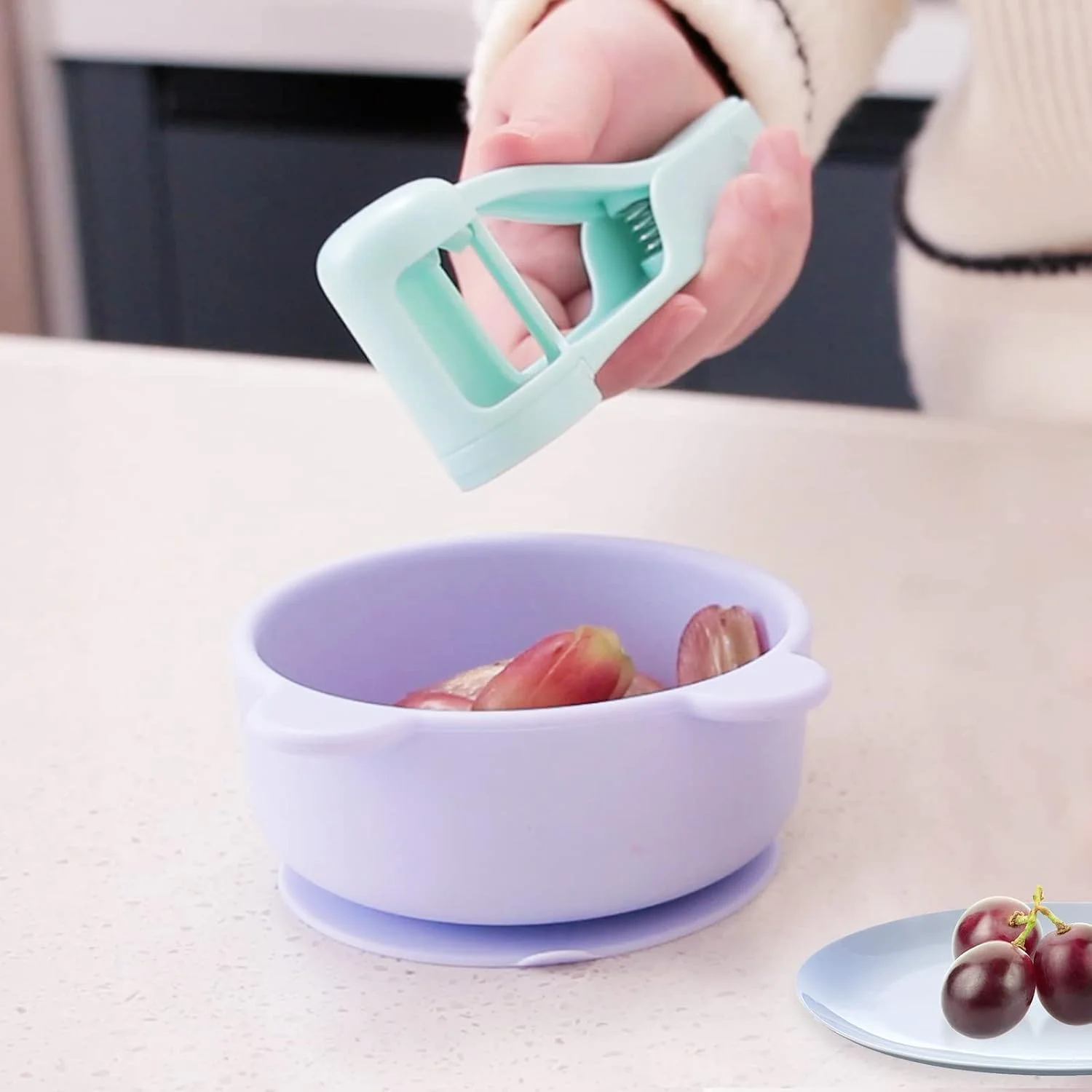
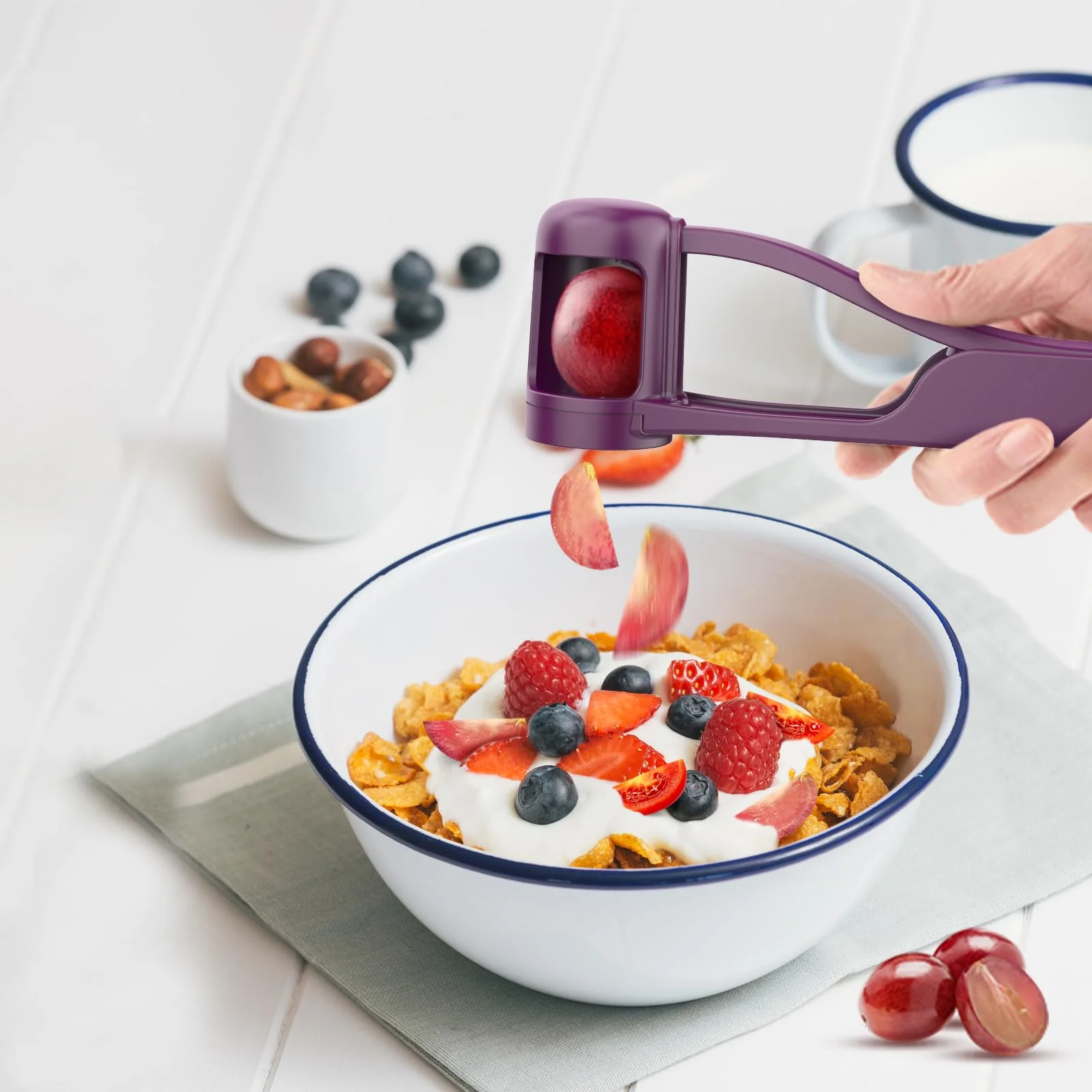
Cutting a bowl of grapes one by one on a board is slow, and slow jobs get skipped on a busy morning. Our grape cutter is a small press. Set a grape stem-end down in the cup, press the lid with your thumb, and it comes out in four pieces. The cup holds the fruit so it does not roll away, and the serrated blades are 304 stainless steel. Cherry tomatoes, strawberries, blueberries and pitted cherries go through the same way.
Four pieces is a start, not a finish. A quartered grape is smaller than a whole one, but whether each quarter stays under the half inch the AAP names depends on the grape. Big grapes give big quarters. Look at the pieces before they go on the plate, and run a knife through any that look large. For a younger toddler, cut them smaller still.
The press does not replace an adult at the table, and no tool does. What it changes is the time the cutting takes, so it happens at every snack and not only when you have a spare minute. It is 6.5 inches long, rinses clean under the tap and goes in the dishwasher. You will find it with our other kitchen gadgets.
At the table: sitting up, and someone watching
The CDC choking page has two rules about the meal itself, and they cost nothing. Watch your child at all times while they are eating. Have your child sit up while eating, with no lying down, crawling or walking. The AAP says the same thing in a few words: supervise mealtimes for infants and young children.
In a real kitchen those rules turn into small habits.
- Fruit is eaten in the high chair or at the table, not on the sofa or on the walk to the car.
- You stay in the room until the plate is empty, even when the phone rings.
- Snacks wait until you arrive, rather than going to a car seat you can only see in a mirror.
- Grapes for a lunch box are cut at home, and whoever sits with your child at lunch knows they are already cut.
Storing homemade baby food in glass jars
Purees bring a different set of rules, and the FDA covers them on its food safety page for new parents. Its first point is about the spoon. The FDA says not to feed a baby from a jar of baby food and then put the jar back in the refrigerator, because saliva on the spoon may contaminate the remaining food. Put a serving on a dish instead.
For homemade baby food, the FDA gives 1 to 2 days in the refrigerator. For the freezer, the same page says to store it for up to three months and to throw out what is left after that. When you freeze in a jar, the FDA says to leave about half an inch of space at the top, because food expands when frozen.
Our glass baby food jars come as twelve 6 oz jars, twelve 7 oz jars or six 8 oz jars, each with a locking lid over a silicone ring. A dry-erase pen comes in the set, so you write the food and the date on the lid the day you fill it. With the FDA's window of 1 to 2 days in the fridge, that date on the lid does a lot of the work. It wipes off for the next batch.
| Step | What the FDA says |
|---|---|
| In the fridge | 1 to 2 days |
| In the freezer | Up to three months, then discard |
| Filling a jar to freeze | Leave about 1/2 inch of space at the top |
| Serving | Put a serving on a dish, do not feed from the jar you keep |
| Warming | Move the food to a dish before it goes in the microwave |
| After the microwave | Stir, let it stand 30 seconds and taste-test |
Warming a serving
The FDA says not to microwave baby food in the jar. Transfer the food to a dish first. For the dish, the FDA suggests about 15 seconds on high power for 4 ounces of solid food, and then to always stir, let it stand 30 seconds and taste-test before feeding. The stir and the wait are part of the method, not extras.
Thaw a frozen jar in the fridge, spoon one serving into a small dish with a clean spoon, and lock the lid back on the rest. Empty jars go in the dishwasher. When the baby food years end, the same jars hold dressings, sauces and snack portions for a lunch box. For the rest of the family, our guide to storing leftovers in glass goes through the fridge and the freezer for bigger dishes.
Every product named here is part of the Luvan kitchen line.